Descriptions in the source
- Bloating that settles in after meals, a foggy head, heavy limbs.
- Everything a little worse when the weather turns damp.
- Feels worse after cold or raw food.
Traditional background
A traditional framework, not a biomedical diagnosis.
The tradition reads this as dampness: fluid that should be flowing instead pooling where it shouldn't, smothering the digestive fire the way wet wood smothers a willing flame. The fire is there. It's just buried under something heavier than it can burn through on its own.
In this framework, digestion is described through a warm, active "digestive fire" and the traditional Spleen system. The point roles below are source language, not a combined prescription or explanation of an individual's symptoms.
When warmth should wait
Bloating with blood in stool, unintended weight loss, persistent vomiting or new severe pain needs clinical assessment. The source also cautions about heat presentations, pregnancy-related limits, altered sensation or damaged skin, and temporary states such as intoxication or exhaustion. This article cannot clear a home method.
Point references
These traditional topic-to-point associations and home instructions are awaiting qualified review.
Traditional context: The source describes warming the centre for a cold-type digestive pattern; timing, method and dose require individual assessment.
REN12: Zhongwan 中脘
Labelled CV12 in the illustration.
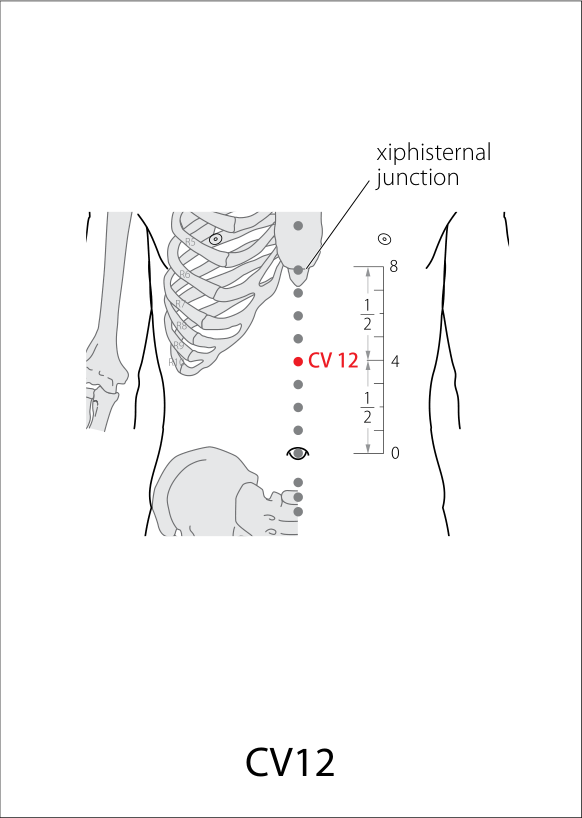
On the upper-abdominal midline, halfway between the navel and the sternocostal angle at the bottom of the breastbone: 4 proportional cun above the navel.
More location detail
On the anterior median line, 4 cun superior to the umbilicus (midway umbilicus to sternocostal angle).
Traditional role: The source discusses this anterior midline point in traditional middle-jiao and digestion descriptions.
See REN12 in the Point Atlas →REN8: Shenque 神闕
Labelled CV8 in the illustration.
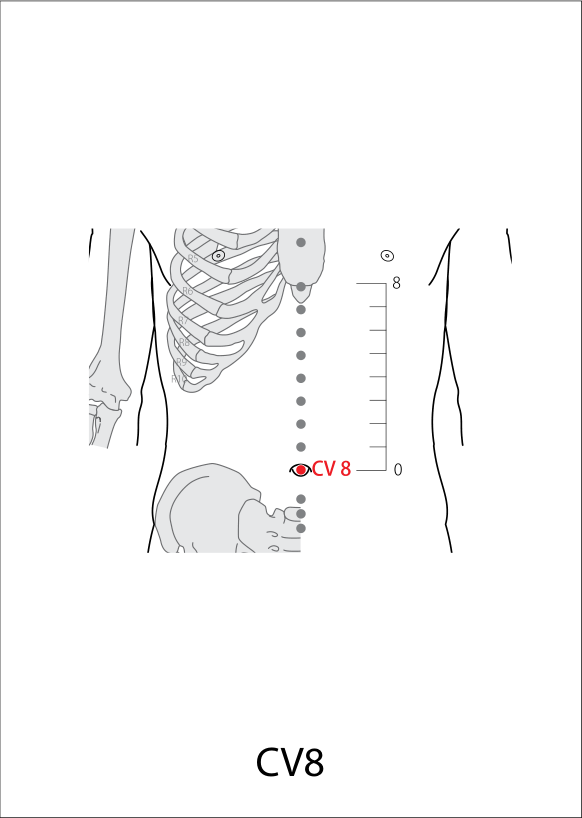
At the centre of the navel. This identifies the anatomical reference only; it is not a placement instruction for an adhesive product.
More location detail
In the centre of the umbilicus.
Traditional role: The source includes this navel point in traditional cold and digestive references; location and method must not be inferred from the name.
See REN8 in the Point Atlas →ST36: Zusanli 足三里
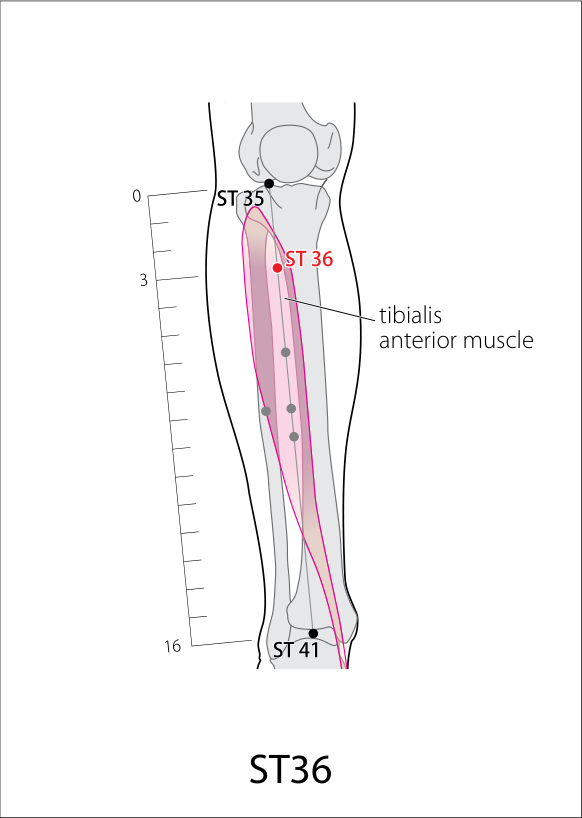
On the front of the lower leg, below the knee and just outside the shinbone. The standard location is 3 proportional cun below ST35, one finger-breadth outside the front edge of the tibia.
More location detail
On the anterior leg, 3 cun inferior to ST35, one finger-breadth lateral to the anterior crest of the tibia.
Traditional role: The source includes this leg point in traditional digestion and health-cultivation discussions.
See ST36 in the Point Atlas →SP9: Yinlingquan 陰陵泉
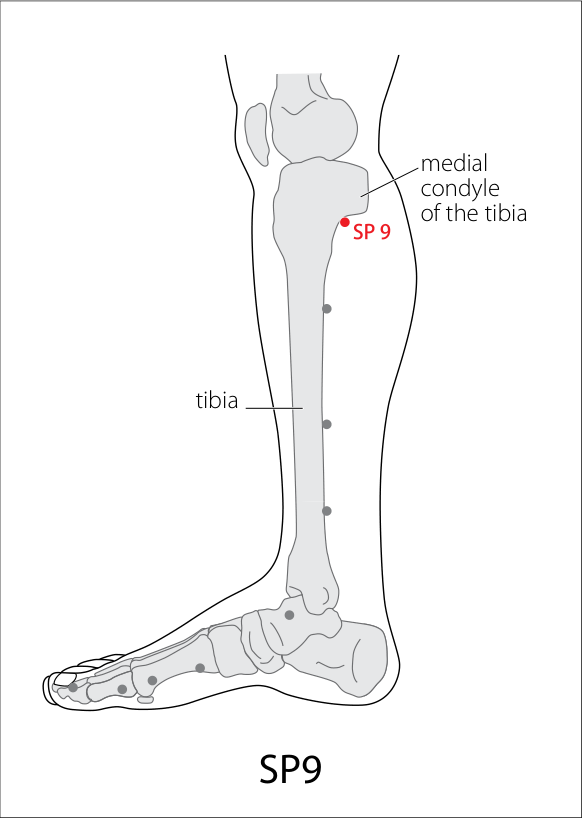
Slide a thumb up the inner shinbone edge until it stops in the hollow below the knee's inner knob.
More location detail
On the medial leg, in the depression below the medial condyle of the tibia, on the lower border of the condyle.
Traditional role: The source discusses this point in traditional dampness and fluid-pattern language; that role is not a treatment recommendation.
See SP9 in the Point Atlas →Point locations: WHO Standard Acupuncture Point Locations (REN12, REN8, ST36, SP9); © WHO.
Common questions
Can moxibustion actually help with bloating, or is that a stretch?
The tradition describes cold-type bloating with heaviness and fog in different terms from heat-type presentations. That distinction is educational context, not proof of cause, efficacy or suitability.
Where can I study the points mentioned?
The Point Atlas provides canonical location references for REN8, REN12, ST36 and SP9. It does not provide a dose, method or permission to apply heat.
Is this different from acupuncture for digestion?
Moxa and acupuncture may reference the same point map, but they are different methods with different risks. A qualified practitioner can assess which, if either, is appropriate.
Does this article give a schedule?
No. Timing, method, dose and supervision are not determined by this educational article.