Descriptions in the source
- Cold-tired: exhausted and cold to the core, with a weak or sore lower back, worse after meals or in cold weather.
- Pale-tired: dizzy when you stand up too fast, a pale face, maybe a foggy memory.
- Stuck-tired: a tight chest, a clenched jaw, sighing you don't notice you're doing.
Traditional background
A traditional framework, not a biomedical diagnosis.
Chinese medicine doesn't treat fatigue as a single condition. It asks what kind of tired you are, because the fix is different depending on the answer. The cold-tired kind is exhausted and cold to the core, with a weak or sore lower back, worse after meals or in cold weather: the kidney and spleen's warming function running low, an inner furnace burned down.
The pale-tired kind is dizzy when standing up too fast, a pale face, maybe a foggy memory: the body's energy and blood reserves both running thin, not broken, just under-filled. The stuck-tired kind comes with a tight chest, a clenched jaw, sighing you don't notice you're doing. Not low fuel, something stuck in the flow, and the fatigue is the cost of holding it there.
When warmth should wait
Fatigue with severe, persistent, unusual or worrying features needs appropriate clinical assessment. Traditional heat, pregnancy, skin-sensation and attention boundaries also matter; this article cannot clear a home method.
Point references
These traditional topic-to-point associations and home instructions are awaiting qualified review.
Traditional context: The source differentiates cold, depleted and constrained fatigue patterns; it does not establish a personal home schedule.
ST36: Zusanli 足三里
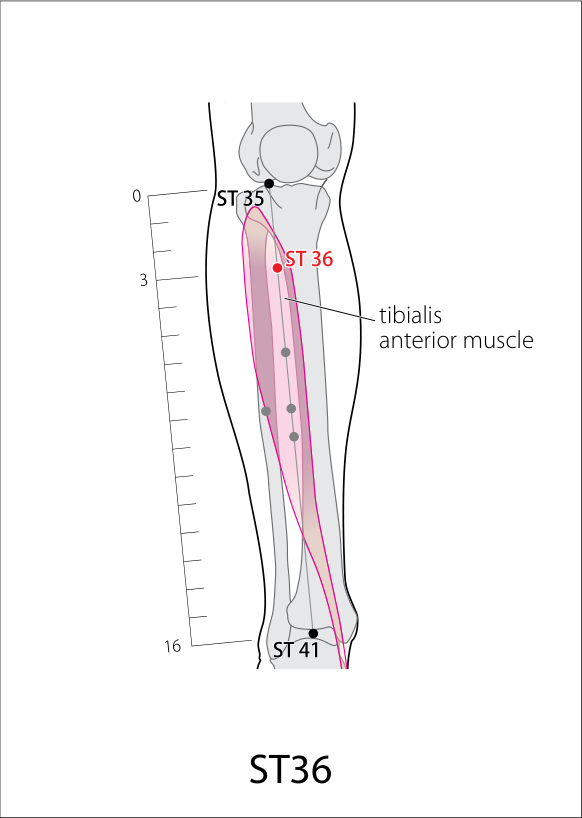
On the front of the lower leg, below the knee and just outside the shinbone. The standard location is 3 proportional cun below ST35, one finger-breadth outside the front edge of the tibia.
More location detail
On the anterior leg, 3 cun inferior to ST35, one finger-breadth lateral to the anterior crest of the tibia.
Traditional role: The source includes this leg point across traditional digestion and health-cultivation discussions.
See ST36 in the Point Atlas →REN6: Qihai 氣海
Labelled CV6 in the illustration.
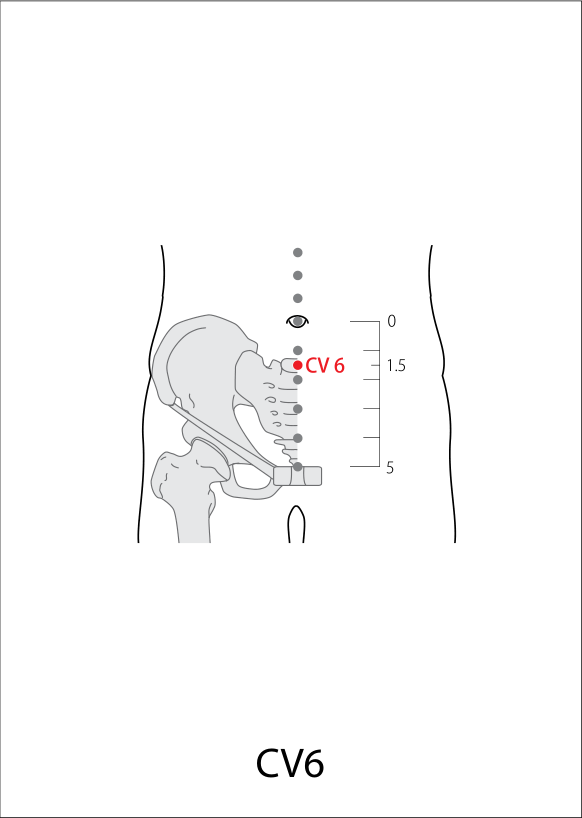
On the midline of the lower abdomen, 1.5 proportional cun below the centre of the navel. Cun is a body-proportion measurement, not a fixed centimetre distance.
More location detail
On the anterior median line, 1.5 cun inferior to the umbilicus.
Traditional role: The source describes this anterior midline point with traditional qi and reserve language.
See REN6 in the Point Atlas →REN4: Guanyuan 關元
Labelled CV4 in the illustration.
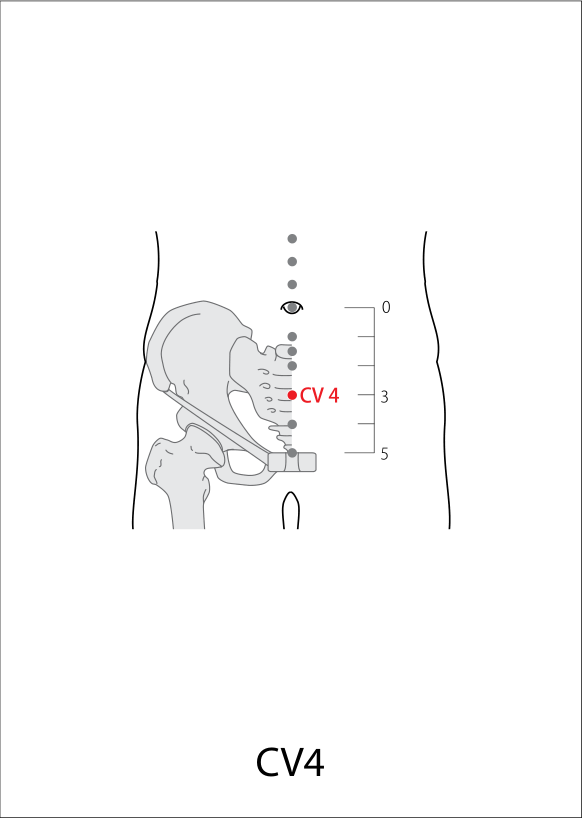
On the midline of the lower abdomen, 3 proportional cun below the centre of the navel. Body-proportion measurement is needed; a palm width is not a universal ruler.
More location detail
On the anterior median line, 3 cun inferior to the umbilicus.
Traditional role: The source discusses this anterior midline point in lower-burner and cold-pattern descriptions.
See REN4 in the Point Atlas →SP6: Sanyinjiao 三陰交
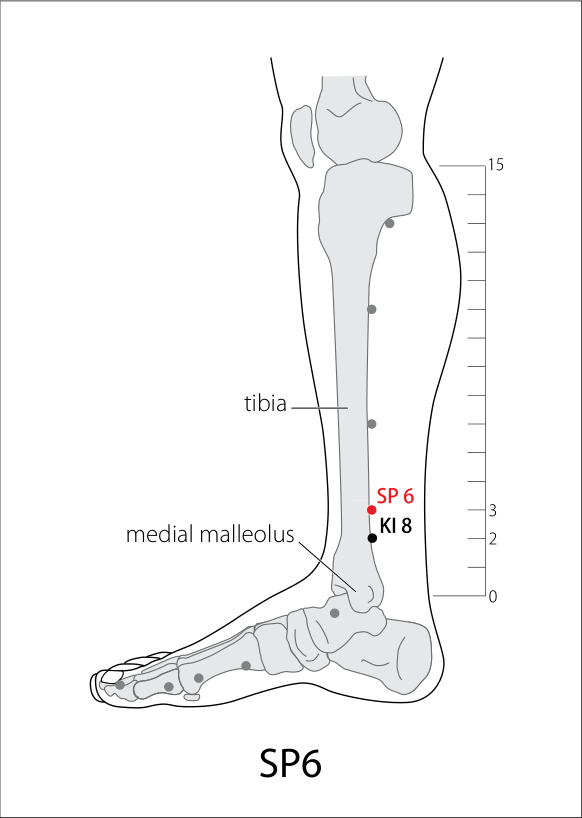
On the inner lower leg, 3 proportional cun above the tip of the inner anklebone, just behind the inner edge of the shinbone.
Covered by the blanket pregnancy rule (classically contraindicated in pregnancy).
More location detail
On the medial leg, 3 cun superior to the tip of the medial malleolus, on the posterior border of the tibia.
Traditional role: The source places this point in traditional blood, channel and pattern descriptions; pregnancy-related cautions matter.
See SP6 in the Point Atlas →BL23: Shenshu 腎俞
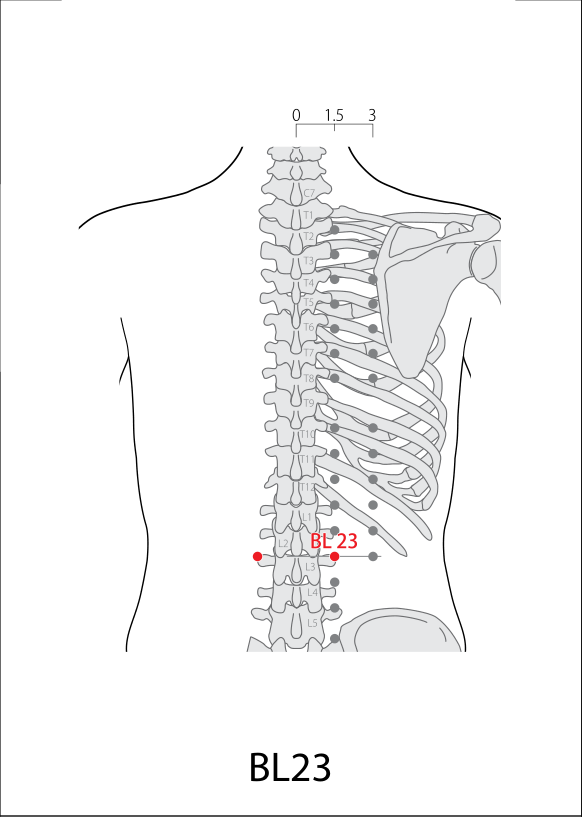
On each side of the lower back, 1.5 proportional cun from the midline at the lower border of the second lumbar vertebra (L2). Identifying that level needs trained help.
Back and neck landmarks can be difficult to identify yourself. An illustration does not establish safe placement.
More location detail
On the lower back, at the lower border of the spinous process of L2, 1.5 proportional cun lateral to the posterior median line.
Traditional role: The source discusses this back point in traditional kidney and low-back descriptions; self-location has practical limits.
See BL23 in the Point Atlas →Point locations: WHO Standard Acupuncture Point Locations (ST36, REN6, REN4, SP6, BL23); © WHO.
Common questions
Are these the same points no matter what kind of tired I am?
No. The tradition maps different fatigue patterns to different points. Zusanli and Qihai show up across more than one, but the full combination changes with the pattern.
How is this different from just resting more?
Rest and medical assessment address different questions. Traditional sources sort fatigue into descriptions such as cold, depletion or constraint; that framework does not identify the cause of fatigue or select a method.
Do I need to see a practitioner to know which type I am?
A short symptom list cannot reliably select a traditional pattern. Persistent, severe or unusual fatigue needs appropriate clinical assessment; the Guide can only show the authored reference and its limits.
Why do the point lists differ?
The source separates pattern-related and symptom-related point roles. The lists are context for reading the reference, not a set to combine or memorise for self-treatment.