Descriptions in the source
- Clenched jaw, tight chest, shoulders that won't drop.
- A sigh that sneaks out when no one's watching.
- Tension that eases when you move, vent, or exercise.
Traditional background
A traditional framework, not a biomedical diagnosis.
That sigh is the tell. The tradition reads this as something stuck rather than something missing: nothing is broken, nothing is empty, your flow of energy has jammed behind a chest that won't fully open. The job of keeping everything moving belongs to the Liver system, a function in this framework, not the organ itself. When that system gets crowded by back-to-back days, screens, and no real off switch, the whole body tightens around it.
This is a traditional description of constraint rather than depletion. It may help explain why the source separates pattern language, point roles and method; it does not establish that warmth or movement will produce a particular result.
When warmth should wait
Traditional constraint language does not establish suitability. The source's cautions include heat presentations, pregnancy-related limits, altered sensation or damaged skin, and temporary states such as intoxication, acute illness or sleep risk. Use the Guide's checks before considering any practice.
Point references
These traditional topic-to-point associations and home instructions are awaiting qualified review.
Traditional context: The source relates this pattern to calming and grounding point selection; it does not establish a personal home schedule.
SP6: Sanyinjiao 三陰交
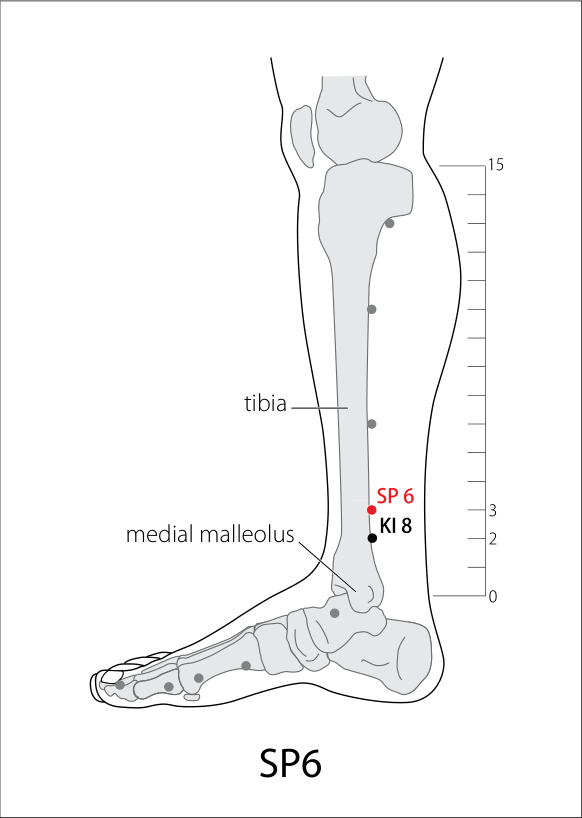
On the inner lower leg, 3 proportional cun above the tip of the inner anklebone, just behind the inner edge of the shinbone.
Covered by the blanket pregnancy rule (classically contraindicated in pregnancy).
More location detail
On the medial leg, 3 cun superior to the tip of the medial malleolus, on the posterior border of the tibia.
Traditional role: The source identifies this point where three channels meet in its traditional channel framework.
See SP6 in the Point Atlas →REN6: Qihai 氣海
Labelled CV6 in the illustration.
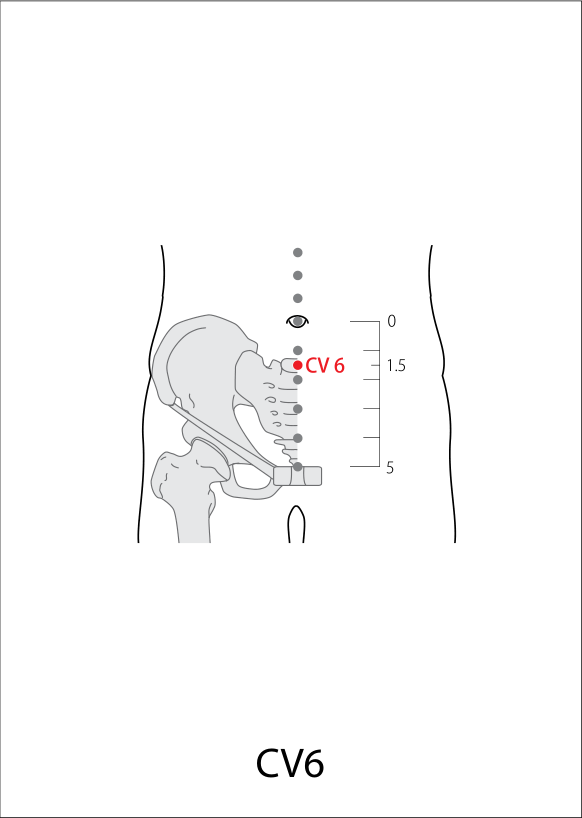
On the midline of the lower abdomen, 1.5 proportional cun below the centre of the navel. Cun is a body-proportion measurement, not a fixed centimetre distance.
More location detail
On the anterior median line, 1.5 cun inferior to the umbilicus.
Traditional role: The source includes this anterior midline point in traditional qi and constraint descriptions.
See REN6 in the Point Atlas →Point locations: WHO Standard Acupuncture Point Locations (SP6, REN6); © WHO.
Common questions
Is moxibustion the same as acupuncture?
They can share point terminology, but they are different methods with different risks and training requirements. A point map does not make a person ready to practise.
How long does a moxa session for stress actually take?
The tradition distinguishes moxa from acupuncture by method and heat, but method, duration and supervision are not determined by an article like this.
Will it smell like anything?
Burning mugwort can involve smoke and a strong herbal smell. The article does not determine whether a particular room, device or method is safe.
What if warmth makes my tension worse, not better?
That is a reason to stop and seek qualified advice. The source distinguishes heat presentations from constraint, but an article cannot make that pattern decision for you.