Descriptions in the source
- Cramps that clearly ease with a heat pack, flow that runs dark with clots.
- A belly that's cold to the touch.
- Breast tenderness and irritability before your period, pain that starts before the bleeding does.
Traditional background
A traditional framework, not a biomedical diagnosis.
The tradition describes some menstrual pain through cold and stagnation language, using flow and lower-abdominal observations as part of its framework. That interpretation does not establish cause or promise that warmth will help.
There are related traditional readings, including cold-sensitive cramps and patterns described with irritability or constraint. They are source distinctions, not a self-assessment that selects points, timing or method.
When warmth should wait
Pregnancy or possible pregnancy, heavy or between-period bleeding, and new or worsening pain require qualified clinical advice. The source also cautions about heat presentations, altered sensation or damaged skin, and temporary states such as intoxication or exhaustion. This article cannot clear a home method.
Point references
These traditional topic-to-point associations and home instructions are awaiting qualified review.
Traditional context: The source distinguishes cold-type menstrual pain from other presentations; timing and point selection require qualified assessment, especially where pregnancy or abnormal bleeding is possible.
REN4: Guanyuan 關元
Labelled CV4 in the illustration.
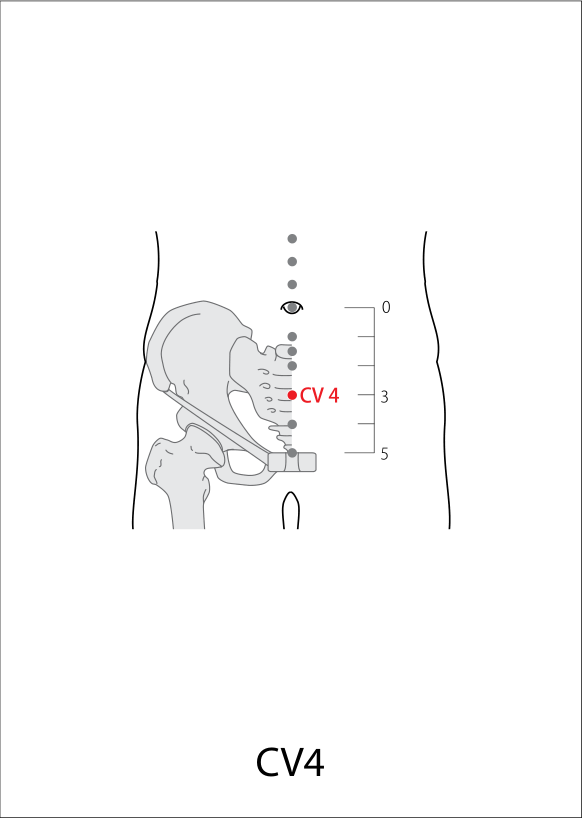
On the midline of the lower abdomen, 3 proportional cun below the centre of the navel. Body-proportion measurement is needed; a palm width is not a universal ruler.
More location detail
On the anterior median line, 3 cun inferior to the umbilicus.
Traditional role: The source discusses this anterior midline point in lower-abdominal and reserve-related traditional descriptions.
See REN4 in the Point Atlas →SP6: Sanyinjiao 三陰交
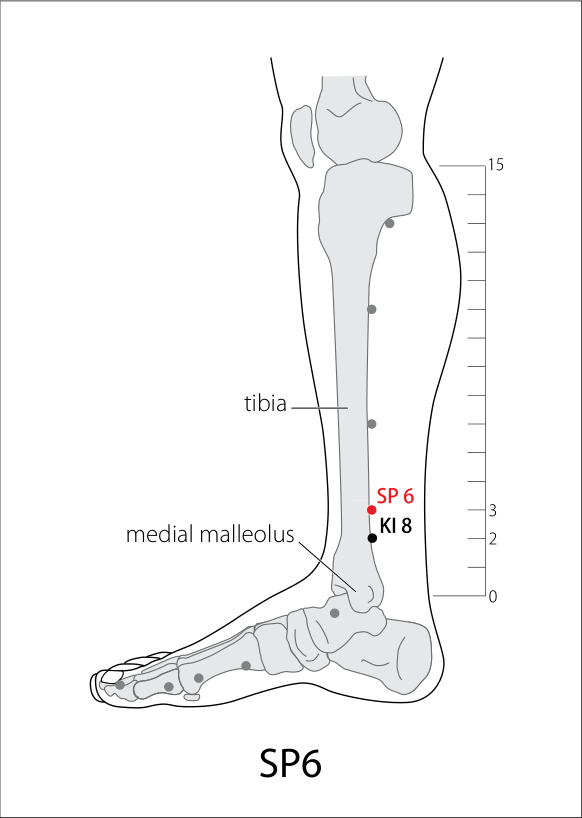
On the inner lower leg, 3 proportional cun above the tip of the inner anklebone, just behind the inner edge of the shinbone.
Covered by the blanket pregnancy rule (classically contraindicated in pregnancy).
More location detail
On the medial leg, 3 cun superior to the tip of the medial malleolus, on the posterior border of the tibia.
Traditional role: The source identifies this point where three channels meet in its traditional channel framework; pregnancy-related cautions matter.
See SP6 in the Point Atlas →REN6: Qihai 氣海
Labelled CV6 in the illustration.
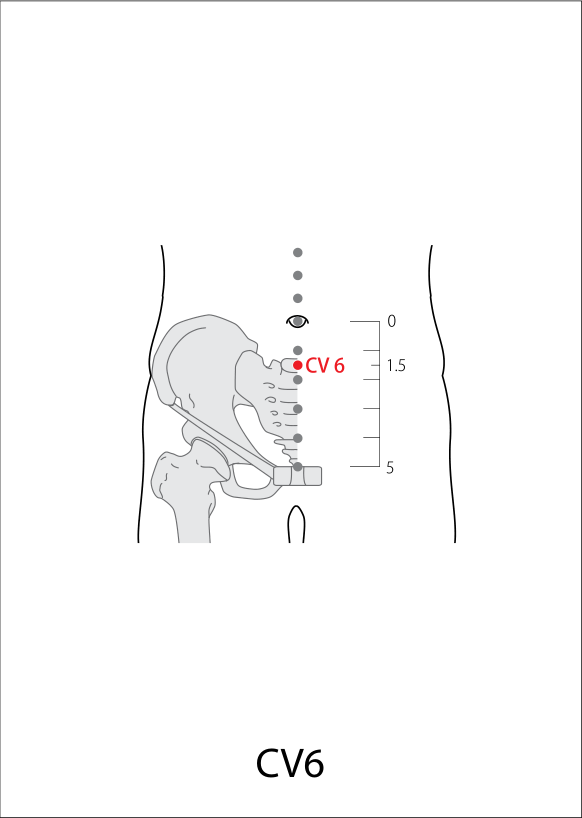
On the midline of the lower abdomen, 1.5 proportional cun below the centre of the navel. Cun is a body-proportion measurement, not a fixed centimetre distance.
More location detail
On the anterior median line, 1.5 cun inferior to the umbilicus.
Traditional role: The source includes this anterior midline point in traditional qi and lower-abdominal discussions; it is not a home instruction.
See REN6 in the Point Atlas →Point locations: WHO Standard Acupuncture Point Locations (REN4, SP6, REN6); © WHO.
Common questions
Does the source schedule a home routine for period pain?
This article does not publish a schedule, dose or method. Timing and point selection require assessment, especially where pregnancy or abnormal bleeding is possible.
Is moxa safe for period pain, or could it make things worse?
Traditional descriptions distinguish cold-sensitive cramps from other presentations, but a heat-pack response does not confirm the pattern. New, severe, worsening or between-period pain needs clinical assessment.
What's the difference between moxa and a regular heating pad for cramps?
A heating pad and moxibustion are different interventions. The Atlas can show the named point locations; it cannot establish that either method or combination is suitable.
Can I use moxa if there's any chance I'm pregnant?
Pregnancy changes the safety context, particularly for lower-abdominal and lumbar regions and for points with pregnancy-related cautions. Seek qualified advice rather than relying on this article.